
 Business License

Laminated Rubber Bearing: Types, Selection & Testing
A 200 m concrete span can grow almost 40 mm longer on a hot afternoon and shrink back overnight. If the bearing between the girder and the pier can't follow that movement, the force has nowhere to go but into the concrete. That's the problem a laminated rubber bearing exists to solve.
If you specify, buy, or inspect structural bearings, you already know the pressure. A bearing that's undersized, poorly bonded, or specified for the wrong movement cracks piers, opens deck joints, and turns a 50-year bridge into a repair project. Getting it right is one of the cheapest insurance policies in the whole structure.
This guide explains how a laminated rubber bearing works, the types available, how to select one from load and movement data, and how to verify quality before the units ship. You'll finish with the specific inputs and test evidence to put in your RFQ.
What Is a Laminated Rubber Bearing?
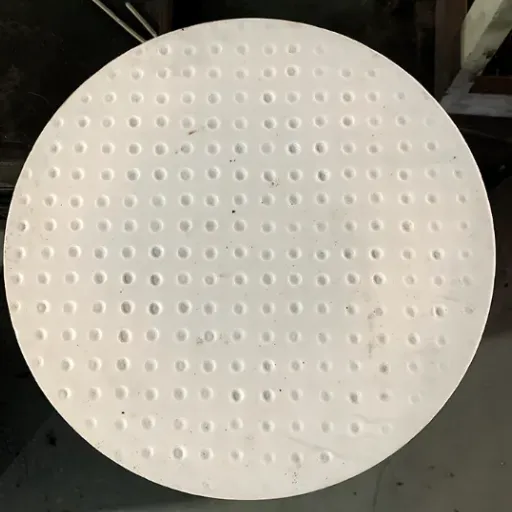
A laminated rubber bearing is a structural support made from alternating layers of rubber and thin steel plates bonded together into a single unit. The rubber carries the movement. The steel plates stop the rubber from bulging sideways under load. Together they transfer heavy vertical loads while allowing the structure above to slide and rotate.
The layers are bonded during vulcanization, the same chemical curing process that turns raw rubber compound into a durable elastic solid. Each rubber layer between two steel plates is called a lamination, and the thickness and number of these layers control how much the bearing can move.
Some engineers call this a laminated elastomeric bearing. In Chinese and many Asian project documents, the same component appears as a plate rubber bearing, coded GJZ. It's the most common type of bridge rubber bearing in the world, and for good reason: it's simple, robust, and needs almost no maintenance.
Why the Layers Matter
Plain rubber alone would be too soft. Under a 2,000 kN girder load, a solid rubber block would squash and bulge outward, losing its shape and its capacity to carry load.
Bonding thin steel plates inside the rubber solves this. The plates restrain the horizontal bulge, so the bearing becomes stiff and strong vertically while staying flexible horizontally. The result is a component with two personalities: hard in compression, soft in shear.
That combination is exactly what a bridge needs. The bearing must be rigid enough to hold the deck up and soft enough to let it move.
How a Laminated Rubber Bearing Carries Load and Allows Movement
A laminated rubber bearing does four jobs at once. Miss any one of them and the structure pays for it.
Carry vertical load: The bearing passes the full dead and live load of the deck into the pier or abutment.
Allow horizontal movement: Thermal expansion, concrete creep, shrinkage, and braking forces all push the deck sideways. The bearing shears to follow them.
Allow rotation: As the deck bends under traffic, the girder ends rotate. The bearing tilts without lifting or cracking.
Share load across supports: On multi-span bridges, the bearings distribute load so no single pier is overloaded.
The critical number here is shear stiffness. A laminated rubber bearing is designed to deform horizontally by a set amount, often 50 mm or 100 mm, without losing its grip or its capacity. The total thickness of rubber in the stack sets that limit. More rubber means more movement range.
This is where underspecification bites. A buyer who selects on vertical capacity alone may get a bearing that is strong enough to hold the deck but too stiff to let it move.
Priya, a bridge engineer on a coastal highway upgrade, inherited a design where the bearings had been picked from a capacity table with no movement check. During the first summer, thermal movement pushed the girders hard against the abutment backwalls and cracked the approach slab. Replacing 24 bearings mid-project cost far more than specifying them correctly would have.
She rebuilt the schedule around two inputs: vertical load and required movement. Every bearing after that carried a documented shear capacity that matched the calculated thermal range. The lesson is simple. Capacity is half the specification. Movement is the other half.
Want the movement and load figures checked against real test data? Talk to our engineers before you lock the bearing schedule.
Laminated Rubber Bearing Types and Where to Use Them
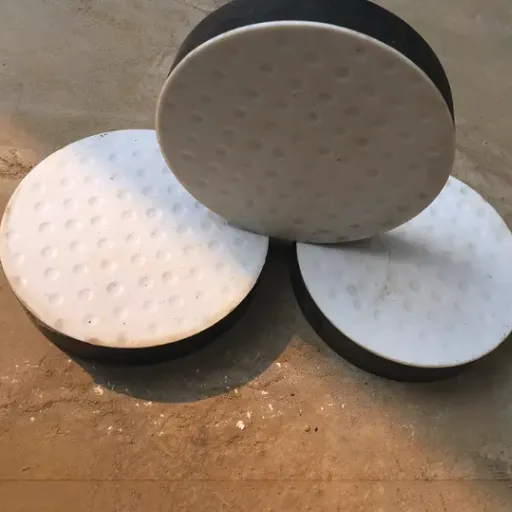
Laminated bearings are not one product. They come in a small family, and the right member depends on the load, the span, and whether the site is seismic.
Plate Laminated Bearing (GJZ)
This is the standard laminated rubber bearing: rubber and steel plies vulcanized into a rectangular block. It allows shear movement and rotation and carries moderate to heavy loads. Use it on highway and rail bridges, building columns, and any structure that needs a simple, maintenance-free support with movement capacity in the tens of millimeters.
PTFE Sliding Laminated Bearing (GJZF4)
Add a polythene or PTFE sliding surface to the top of a laminated bearing and you get large movement capacity, often 100 mm and beyond, plus low friction. Sliding laminated bearings are the workhorse for long spans and continuous decks where thermal movement is measured in the hundreds of millimeters. The rubber handles rotation; the sliding plate handles the long travel.
Lead Rubber Bearing (LRB)
For seismic regions, a lead plug is inserted through the center of a laminated bearing. The lead core yields under strong shaking and absorbs energy, while the rubber provides the restoring force that pulls the structure back. This seismic rubber bearing doubles as an isolator and is common on bridges and buildings in high-seismic zones, where the goal is seismic isolation rather than simple movement.
When a Laminated Bearing Is Not Enough
Very heavy loads or very high rotation demands can exceed what a simple laminated stack handles within sensible dimensions. That's where pot bearings and spherical bearings take over. A pot bearing confines a rubber disc inside a steel cylinder, giving very high load capacity with controlled rotation.
| Bearing Type | Movement | Rotation | Best For |
|---|---|---|---|
| Laminated rubber bearing | Moderate shear; large travel with a PTFE slider | Moderate | Standard bridges and buildings; seismic sites with a lead core |
| Pot bearing | Sliding via PTFE | High | Heavy loads, high rotation demands |
| Spherical bearing | Sliding via PTFE | Very high, any direction | Long spans, complex geometry |
The choice between a laminated bearing and a pot bearing is a real design decision, not a price decision. Our comparison of plate bearing vs pot bearing walks through the loading and rotation limits that force the switch.
For lighter structures such as small footbridges, precast culverts, and building supports, a plain rubber bearing pad without steel laminations may be all the support required.
Materials and Manufacturing: Preventing Delamination
The single most common way a laminated rubber bearing fails is delamination, the separation of rubber from steel inside the stack. It doesn't happen by accident. It happens when the process behind the bearing is weak.
A laminated rubber bearing is only as good as three control points.
1. Raw Material Qualification
The rubber compound and the steel plates are qualified before production starts. Rubber grade, hardness, and aging resistance are confirmed against the specification. Steel plate thickness and surface preparation are checked, because bonding depends on a clean, prepared surface. Off-spec or aged compound is rejected at the door.
2. Controlled Mixing and Vulcanization
Rubber mixing must be consistent batch to batch. Vulcanization temperature, pressure, and time are then controlled so the bond forms fully across every layer. Under-cured or over-cured bearings lose strength, and a poor bond sets up delamination years later.
3. Bonding Under Pressure
During vulcanization, the rubber and steel are pressed and heated together so the compound chemically bonds to the plate. This rubber-steel bonding step decides whether the finished laminated rubber bearing behaves as one solid unit or as a stack of loose parts.
Good manufacturing keeps the shape factor and the bond intact. A supplier with documented process control can show you records for all three points.
How to Select a Laminated Rubber Bearing
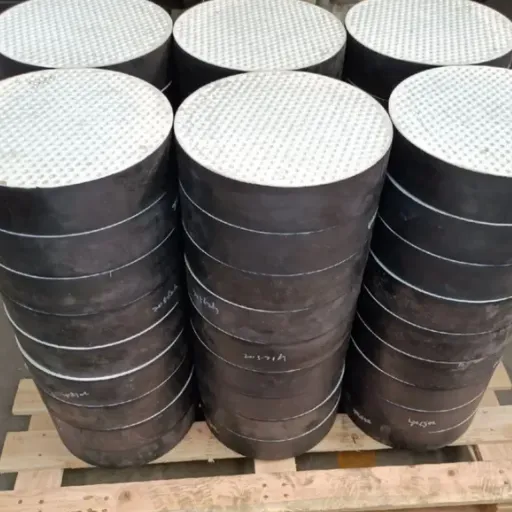
Selecting a laminated rubber bearing follows from the structure, not from a catalog page. Gather these inputs first, and the bearing type and dimensions fall out of the calculation.
Vertical load. The maximum unfactored and factored load the bearing must carry, including dead load, live load, and any uplift.
Required horizontal movement. The thermal, creep, shrinkage, and seismic movement range the design demands.
Rotation. The maximum rotation from girder bending and construction tolerances.
Seismic demand. Whether the site requires energy dissipation, which points toward a lead rubber bearing.
Environment. Temperature range, ozone and UV exposure, and chemical contact all affect the rubber compound choice.
Geometry. Available space under the girder and the pier seat dimensions.
With those six inputs, the supplier sizes the bearing so it keeps compressive strain and shear strain within limits, and so the steel plates control bulge. None of this is guesswork. It's arithmetic, and it must be done against the movement, not just the load.
A useful sanity check: ask the supplier to show the bearing deflecting to its rated shear movement in a test, not just its compression. If the data covers load only, the movement case is unverified.
Testing, Standards, and Quality Verification
Test evidence is what separates a bearing from a promise. Before you issue a purchase order, know which tests confirm bearing load capacity and shear movement, and which standards govern them.
Typical laminated rubber bearing tests cover:
Compression and load capacity: confirms the bearing carries rated vertical load without excessive deflection.
Shear resistance: confirms the bearing handles horizontal movement at rated deflection.
Seismic performance: for lead rubber bearings, energy dissipation and damping under cyclic load.
Fatigue durability: repeated loading to confirm the bearing holds up over its design life.
Bond and aging checks: confirms the rubber-steel bond and resistance to aging and ozone.
The governing standards vary by market and project. The international reference for elastomeric bearings is ISO 6446, while European projects commonly follow EN 1337-3 and US highway work follows AASHTO LRFD Section 14. Materials testing often references ASTM methods. Your project specification will name the controlling standard, and the supplier's test reports should match it.
Two habits protect a buyer here. First, ask for batch reports, not a single type-test certificate. Type tests prove a design once; batch reports prove the units you receive. Second, check that the report covers movement, not just load.
Marcus, a procurement lead for a waterway crossing, asked three bearing suppliers for shear and fatigue test data on the exact bearing size he was buying. Two sent capacity tables and a generic brochure. One sent batch load, shear, and fatigue results with the raw material certificates attached.
He awarded the order to the third supplier. His inspection authority accepted the documentation without a single follow-up query, and the bearings were signed off at the first site inspection. The paperwork cost the supplier nothing extra. It saved Marcus weeks.
At Hengshui Ruibin New Materials LLC, every bearing batch is sampled and tested for load capacity, shear resistance, seismic performance, and fatigue durability. We run full-process quality control from raw material inspection through finished product testing, and we hand over the bearing test reports so your inspector can verify them independently.
Installation, Service Life, and Maintenance
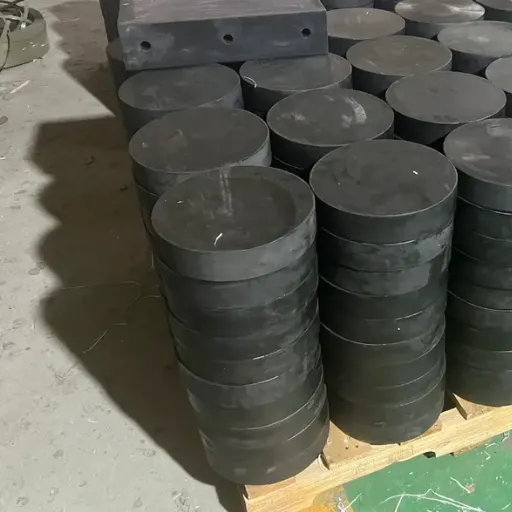
A correct laminated rubber bearing installed wrong still fails. Installation discipline matters as much as the specification.
Seat the bearing flat. The bearing must sit on a level, clean bearing seat with full contact. Point loads from a rough or dirty seat concentrate stress and shorten life.
Respect temperature at installation. Install at a temperature near the middle of the design range so the bearing starts with movement available in both directions.
Keep it aligned. Offset or eccentric placement forces the bearing to shear from day one and eats its movement allowance.
Protect during construction. Temporary loads and debris can damage the rubber surface before the deck is finished.
Once installed, a laminated rubber bearing is largely maintenance free. There's nothing to lubricate and nothing to paint. It's designed for a service life on the order of 50 years or more, matching the structure it supports. Periodic inspection should look for surface cracking, bulging, or any sign of layer separation, and it should confirm the bearing is still free to move.
When a bearing does need replacement, the cause is usually traceable to one of three things: underspecified movement, a weak rubber-to-steel bond, or installation error. All three are preventable at the specification and manufacturing stage.
Conclusion: Specifying a Laminated Rubber Bearing With Confidence
A laminated rubber bearing is the quiet component that lets a bridge move without breaking. Get it right and it disappears into the structure for decades. Get it wrong and it becomes the reason a project runs over budget.
Five takeaways to carry into your next specification:
A laminated rubber bearing is rubber plies and steel plates bonded by vulcanization into one unit, stiff in compression and soft in shear.
Capacity is only half the spec. Shear movement and rotation must be defined and verified.
Match the type to the job: plate bearing for standard supports, sliding laminated for long movement, lead rubber for seismic sites, pot bearings for extreme loads.
Delamination is prevented by controlled raw material, mixing, vulcanization, and bonding, all documented.
Insist on batch test reports covering load, shear, seismic, and fatigue, in line with your governing standard.
Share your load, movement, rotation, and seismic requirements with our engineering team and we'll confirm the right laminated rubber bearing type and size before you order. Request a quote and we'll send a recommendation with the supporting test data.
Recently Posted
-
FRP Cable Tray Guide: Types, Benefits & Sourcing
September 23, 2026On a humid Monday in June 2025, the maintenance crew at a coastal desalination plant in the Philippines found rust flakes scattere Read More
 -
Fiberglass Cable Tray Guide: Types, Benefits & Sourcing
September 22, 2026On a Thursday in September 2024, the electrical team at a chlor-alkali plant in Gujarat pulled the third galvanized steel cable tr Read More
 -
FRP Grating Standards and Test Reports: A Buyer's Guide
September 21, 2026In March, Mateo Silva, a project engineer on a fertilizer terminal expansion in Chile, rejected an entire shipment of fiberglass g Read More
 -
Rubber Bearing for Bridges: Installation & Inspection Guide
September 20, 2026The bearings were perfect when they left the factory. Every batch test had passed. Then a site crew set them on plinths that were Read More

Contact Us
Recommended Products
-
 Corrosion Resistant Grating Board FRP Fiberglass Grating for Sidewalk FloorNegotiableMOQ: 100 Square Meters
 -
Outdoor Fiberglass Ladder Type FRP GRP Cable Tray for Industrial Cable SupportNegotiableMOQ: 50 Meters
-
FRP Pultruded Box Section Profiles as Durable Building Material for ConstructionNegotiableMOQ: 300 Pieces
-
FRP/GRP U-Shape Trench Cover for Road Drainage ApplicationsNegotiableMOQ: 1 Set
-
Steel Grating Drainage Cover and Catwalk Walkway GratingNegotiableMOQ: 300 Square Meters
-
Sliding Neoprene Elastomeric Bridge Bearing Pad for Expansion Joints Low FrictionNegotiableMOQ: 1 Piece
-
FRP Plastic Septic Tank for Chemical Plant School Hotel Hospital Sewage TreatmentNegotiableMOQ: 1 Set
-
Customized High Load Polymer Concrete Drainage Channel - OEM AvailableNegotiableMOQ: 1 Set
-
Pot Type Bridge Rubber Bearing Pad for Seismic Isolation and Shock Absorption SupportNegotiableMOQ: 50 Pieces
-
Outdoor FRP Ladder Cable Tray UV Stabilized GRP Fiberglass Ladder Tray for Solar Power StationNegotiableMOQ: 50 Meters
-
Anti-Aging FRP Fiberglass GRP Pultrusion Grating for Outdoor ApplicationsNegotiableMOQ: 100 Square Meters
-
China Manufactures High Performance Bridge Rubber Pot BearingNegotiableMOQ: 1 Piece
-
Weatherproof Structural FRP Square Rectangular Tube Pultruded Profile for Outdoor UseNegotiableMOQ: 300 Pieces
-
Isolation Spherical Bearing and Damping Pad for Bridge Seismic ProtectionNegotiableMOQ: 300 Pieces
-
Fiberglass FRP/GRP Biogas Septic Tank for Sewage Treatment and PurificationNegotiableMOQ: 1 Set
-
Fiberglass Reinforced Plastic Grating for Walkway Flooring, FRP GRPNegotiableMOQ: 100 Square Meters
-
C-Channel FRP/GRP Pultruded Profiles for Structural SupportNegotiableMOQ: 300 Pieces
-
High Durability Molded FRP Grating for Walkways, GRP FiberglassNegotiableMOQ: 100 Square Meters
-
Laminated Rubber Bearings for Bridge and Building Seismic Isolator ApplicationsNegotiableMOQ: 50 Pieces
-
FRP Fiberglass Ladder Cable Tray for Power Supply and Electrical Wiring SystemsNegotiableMOQ: 50 Meters