
 Business License

How to Choose a Fiberglass Septic Tank Supplier
A reliable fiberglass septic tank supplier should match the tank to the wastewater load, site conditions, required approvals, and installation method, then document that match with drawings and test information. A catalog capacity alone is not enough to place a safe, technically complete order.
That distinction matters because an underground tank is only one part of an onsite wastewater system. The US Environmental Protection Agency describes a typical system as a buried tank, an effluent distribution system, and a soil absorption area. Soil, groundwater, wastewater characteristics, and system design all affect performance. Your supplier can support the tank selection, but the responsible designer and local authority must approve the complete system.
This guide explains how to compare a fiberglass septic tank supplier, prepare a useful request for quotation, and spot gaps before manufacturing or shipment begins.
Key Takeaways
Give each fiberglass septic tank supplier the same design flow, site, connection, load, and compliance information so quotations are comparable.
Confirm effective capacity, chamber layout, burial limits, groundwater conditions, and surface loads before accepting a model.
Request model-specific drawings, material information, inspection records, and installation instructions from the fiberglass septic tank supplier instead of relying on broad marketing claims.
Treat local permits and product approvals as project inputs, not paperwork to resolve after delivery.
Define included fittings, packaging, inspection, delivery terms, warranty scope, and installation support in the purchase documents.
Start With the Project, Not a Generic Tank Size
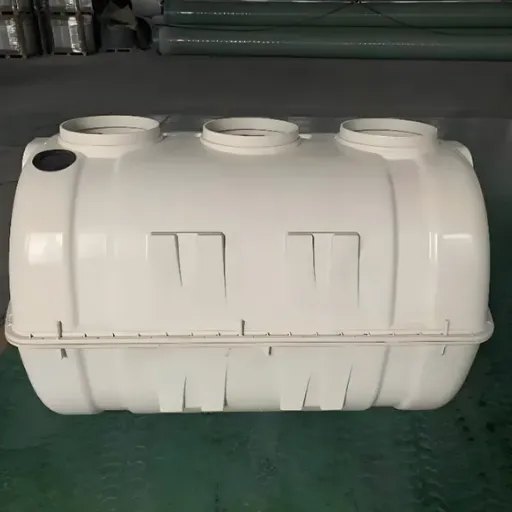
The first question for a fiberglass septic tank supplier should not be “Which size is most popular?” It should be “What does this project require?” Capacity depends on the applicable local rule, wastewater flow, occupancy, retention basis, sludge allowance, and system arrangement.
A septic tank is not the same as a holding tank or packaged treatment unit. A septic tank retains solids while liquid moves to the next treatment or dispersal stage. A holding tank stores wastewater for removal.
An enhanced treatment unit may add biological or mechanical processes. If a quotation mixes these terms, ask the fiberglass septic tank supplier to define the equipment and process boundary.
For projects in the United States, the EPA defines a large-capacity septic system as one that receives only sanitary waste and can serve 20 or more people per day. That definition is specific to the United States. Other countries and local authorities may use different thresholds, sizing rules, product approvals, and discharge requirements.
Establish the design basis
Before contacting a fiberglass septic tank supplier, prepare these inputs:
Building or facility type and expected occupancy
Domestic sanitary wastewater flow, including average and peak assumptions
Required nominal and effective volume, if already designed
Retention and sludge-storage basis used by the project engineer
Required number of chambers and internal flow arrangement
Destination country, permitting authority, and applicable standard
Downstream connection, treatment, or dispersal arrangement
Do not copy a capacity from a residential table into a hotel, school, camp, commercial building, or municipal project. The EPA's historical onsite wastewater design manual notes that a tank volume of two to three times daily design flow was common in the residential context it discusses, but that is not a universal rule. The current local code and approved project design control the selection.
Request a Project-Specific Quote
Send Ruibin New Materials the application, design flow, required capacity, chamber arrangement, dimensions, site conditions, applicable standard, quantity, and destination. Review available FRP septic tanks before preparing the inquiry.
Illustrative scenario: same capacity, different project
Illustrative scenario: A buyer requests two tanks with the same nominal capacity. One will sit below a landscaped area with a low seasonal water table. The other will be installed near a service road in saturated soil. Although their volume is identical, the burial, groundwater, surface-load, anchoring, and access requirements are not.
A useful fiberglass septic tank supplier quotation would separate those configurations. A weak quotation would treat them as the same product because the capacity line matches.
What a Fiberglass Septic Tank Supplier Should Confirm
Once the design basis is clear, the fiberglass septic tank supplier should translate it into a defined tank configuration. Every critical item should appear on the quotation, data sheet, or general arrangement drawing.
Capacity, geometry, and chamber arrangement
Ask whether the stated volume is nominal, total internal, liquid, or effective working capacity. Confirm the number of chambers, partition positions, flow openings, and any sludge or scum allowances defined by the design.
The proposed geometry must also work for production, transport, excavation, and installation. Request overall length, width or diameter, height, empty weight, lifting points, access-opening locations, and the shipping envelope. If delivery involves a container, route restriction, or limited crane access, resolve it before final drawings are approved.
Connections and access
A fiberglass septic tank supplier should request or confirm:
Inlet and outlet diameter
Invert elevations and required slope interfaces
Connection type and allowable field adjustment
Baffles or sanitary tees
Effluent filter, if specified
Access openings, risers, and lids
Vent connection
Pump, level control, or sampling provisions, if applicable
Lifting and handling points
Small interface errors can create large site problems. An outlet shown at the wrong elevation may affect downstream gravity flow. A riser that is absent from the quotation may become an unplanned local purchase. A product photo cannot replace a dimensioned drawing.
Burial, groundwater, and surface loading
Underground conditions belong in the RFQ. Provide minimum and maximum cover, soil information, groundwater elevation, flood risk, frost or temperature conditions, and expected surface use. State whether the area is landscaped, pedestrian, parking, or subject to heavier traffic.
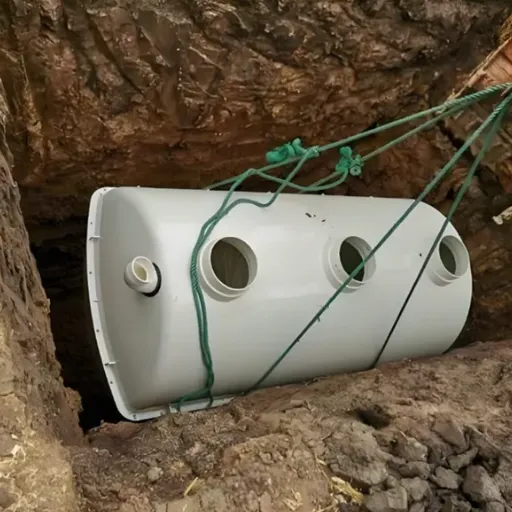
Lightweight construction can reduce handling demands. It also makes buoyancy review important. Guidance from the University of Maryland notes that saturated soil can lift a tank.
A buoyancy analysis should compare tank weight, soil weight, and the force from displaced water. Do not improvise anchors or straps from a generic detail. Require a project-reviewed restraint plan when groundwater creates flotation risk.
The fiberglass septic tank supplier should also define bedding, backfill material, layer thickness, compaction, excavation clearance, water filling during installation, and any restrictions on machine compaction near the shell. Installation instructions must correspond to the offered model.
Video: see the installation sequence, then verify the project method
The following third-party video shows a fiberglass septic tank installation sequence. It is included for visual orientation only. It does not replace the selected manufacturer's manual, engineering review, permit requirements, or site-specific safety plan.
Material, Structure, and Evidence to Request
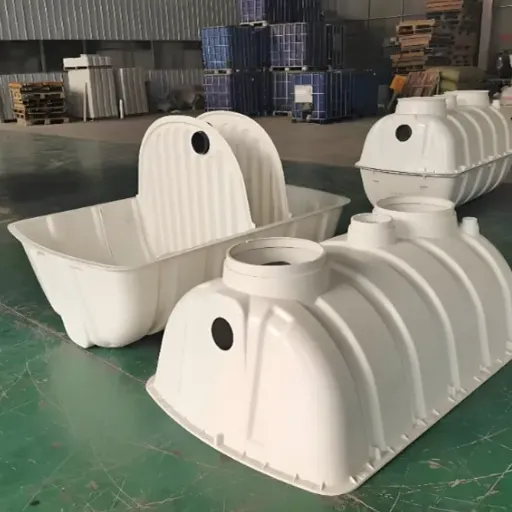
FRP, GRP, and fiberglass are overlapping terms for a composite system that uses glass reinforcement with a polymer matrix. The name alone does not tell you the resin, reinforcement architecture, laminate thickness, manufacturing method, structural capacity, or resistance to a specific exposure.
Ask what is being offered
The fiberglass septic tank supplier should identify the proposed material system and configuration for the selected model. Ask for the resin and reinforcement description, manufacturing method, laminate or wall-build information, joint details, and any internal or external protective layers.
Material selection should consider the actual wastewater and temperature. Domestic sewage differs from industrial wastewater, which may contain solvents, acids, alkalis, oils, or higher temperatures.
If the stream includes non-sanitary waste, disclose it and request a media-specific review. “Corrosion resistant” does not mean resistance to every chemical at every concentration and temperature.
Tie structural claims to defined conditions
Statements such as “high strength” or “heavy load” have little procurement value without boundaries. Ask the fiberglass septic tank supplier to state the design assumptions for the exact model:
Minimum and maximum soil cover
Groundwater condition
Soil and backfill assumptions
Surface or traffic load, where applicable
Internal operating condition
Empty, lifting, transport, and installation cases
Openings, penetrations, and reinforcement details
Applicable design method or project specification
The responsible project engineer should confirm that these assumptions match the site. If a supplier cannot provide a structural basis, the buyer cannot determine whether a claim applies.
Define inspection and acceptance records
Agree on the inspection and test plan with the fiberglass septic tank supplier before production. Depending on the project, the submittal may include dimensional inspection, visual examination, material records, laminate checks, watertightness testing, or other specified verification. Each record should identify the model, order, acceptance criterion, test method, date, and responsible party.
Hengshui Ruibin New Materials LLC publicly describes raw-material checks, process control, and finished-product testing in its general quality information. Buyers should still request the exact procedures and records available for the selected tank and order. This keeps the statement accurate and makes the acceptance package project-specific.
Illustrative scenario: a certificate is not the product scope
Illustrative scenario: A procurement team receives a certificate image with a supplier quotation. The image does not show the covered product model, issuing body, certificate number, standard version, or validity date. The team asks for the complete document and discovers that further confirmation is needed before it can be used for project approval.
The lesson is simple: do not evaluate certification by logo count. Verify the holder, scope, model, issuer, standard, report reference, and validity. A capable fiberglass septic tank supplier should distinguish between company-system documents and product-specific approval.
How to Compare Fiberglass, Concrete, and Polyethylene Tanks
There is no universally best material for every septic project. Compare the complete installed system, local approval path, logistics, and maintenance plan.
| Decision factor | Fiberglass/FRP | Concrete | Polyethylene | What the buyer should verify |
|---|---|---|---|---|
| Handling | Often lower empty weight | Typically heavier | Often lower empty weight | Equipment, access, lifting plan, and damage controls |
| Corrosion behavior | Depends on resin, laminate, and exposure | Depends on mix, wastewater, and protective design | Depends on polymer and exposure | Media, temperature, evidence, and maintenance |
| Underground structure | Model-specific shell and reinforcement | Mass and reinforcement are key | Molded geometry and reinforcement are key | Cover, groundwater, soil, and surface-load limits |
| Buoyancy | Requires review at wet sites | Can also require review | Requires review at wet sites | Site-specific buoyancy calculation and restraint plan |
| Connections | Factory or field interfaces | Cast or field interfaces | Molded or field interfaces | Sizes, elevations, seals, and allowable adjustment |
| Approval | Jurisdiction-specific | Jurisdiction-specific | Jurisdiction-specific | Approved product/listing and permit requirements |
| Shipping | Size and support arrangement matter | Often sourced locally due to weight | Size and support arrangement matter | Packaging, route, unloading, and inspection |
Do not accept fixed lifespan or savings percentages without a defined design, environment, maintenance regime, and evidence. Service-life expectations depend on the entire configuration and operating conditions.
For buyers sourcing several infrastructure items, Ruibin's FRP and bearing product range provides context. Keep each technical package separate so septic-tank requirements do not become mixed with drainage, grating, or structural-product specifications.
How to Evaluate a Fiberglass Septic Tank Supplier
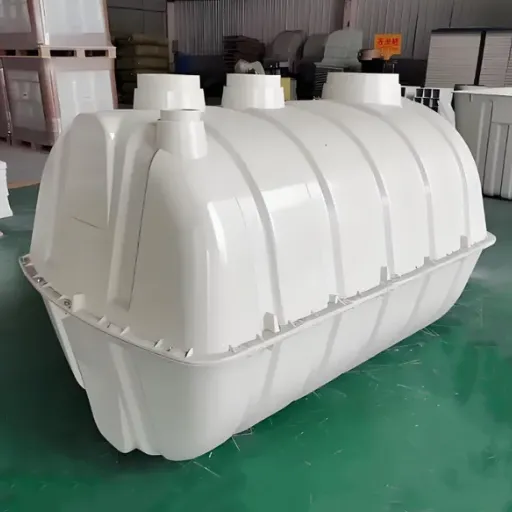
Supplier evaluation should cover technical control, quality records, commercial clarity, and communication. A polished landing page may help you discover a company, but it does not replace the order documents.
Review the technical submittal package
At minimum, request the following from each fiberglass septic tank supplier:
General arrangement drawing with dimensions and connections
Nominal and effective capacity statement
Chamber and internal-component layout
Material and laminate/build specification
Empty weight and lifting instructions
Burial, groundwater, backfill, and load assumptions
Installation manual for the proposed model
Inspection and test plan
Available product approvals and supporting reports
Packing and shipping drawing where required
Mark each document as required for quotation, approval, production, pre-shipment inspection, or final handover. This prevents the phrase “documents available” from hiding a schedule gap.
Ask process-control questions
Useful questions include:
How are resin, glass reinforcement, fittings, and other incoming materials identified?
Which manufacturing parameters are recorded for the tank?
How are dimensions and connection elevations checked?
Which visual or physical acceptance criteria apply?
How are repairs and deviations documented?
Can the buyer or an agreed third party inspect before shipment?
Which records remain traceable to the order and tank?
Ruibin New Materials presents itself as a manufacturer in its public company profile. Because public profile fields are supplier-stated, procurement teams should verify the legal entity, factory scope, quality documents, and order-specific capability during qualification.
Define the commercial package
A technically suitable tank can still produce a poor purchase if the commercial boundary is vague. Ask the fiberglass septic tank supplier to confirm quantity, included fittings, spare items, packing, Incoterm, destination port, inspection access, document language, production schedule, shipping schedule, and payment milestones.
Ask the fiberglass septic tank supplier what installation guidance and after-sale support are included. Do not assume that a quotation includes site labor, lifting, excavation, anchoring design, commissioning, or local permit support. Put the agreed responsibility matrix in writing.
Illustrative scenario: the cheapest quotation changes after award
Illustrative scenario: Three companies quote the same tank description. The lowest-priced fiberglass septic tank supplier excludes risers, internal baffles, export supports, and pre-shipment inspection. Those items appear only after technical clarification, removing the apparent saving and delaying approval.
A structured RFQ reduces that risk. Compare the total defined scope, not the first number in the price column.
Need a configuration review?
Send the design basis and drawings to Ruibin New Materials. Ask the team to identify included tank components, available order documents, installation requirements, packaging, and delivery assumptions. You can also review the company's technical guides for related specification topics.
RFQ Checklist and Red Flags
Use one RFQ schedule for every fiberglass septic tank supplier. Leave unknown items marked “to be confirmed” instead of guessing.
| RFQ field | Information to provide or request |
|---|---|
| Application | Residential, hotel, school, commercial, municipal, camp, or other |
| Waste stream | Domestic sanitary sewage; identify every non-sanitary component |
| Design basis | Average and peak flow, occupancy, required retention/sizing rule |
| Capacity | Nominal and effective volume, chambers, sludge allowance |
| Geometry | Orientation, dimensional limits, access and shipping constraints |
| Connections | Inlet/outlet sizes and elevations, vents, risers, lids, filters |
| Site | Soil, groundwater, flood risk, temperature, burial depth |
| Loads | Surface use, traffic or surcharge, lifting and installation cases |
| Installation | Bedding, backfill, compaction, anchoring, access, equipment |
| Materials | Resin, reinforcement, build method, exposure requirements |
| Compliance | Country, authority, standard, approvals, inspection documents |
| Commercial | Quantity, Incoterm, destination, packaging, required schedule |
Red flags in a fiberglass septic tank supplier quotation
Capacity is shown without saying whether it is nominal or effective.
The offered tank is not connected to a model drawing.
Burial depth, groundwater, soil, and surface loads are absent.
A universal “leak-proof” or corrosion claim has no test or exposure boundary.
Certificate logos appear without scope and traceable documents.
Inlet, outlet, risers, baffles, lids, or filters are not clearly included or excluded.
Installation guidance is generic and does not identify the model.
Packing, lifting, inspection, delivery terms, or document handover are undefined.
The seller guarantees local approval without reviewing the jurisdiction.
Fixed service life, zero maintenance, or fixed savings are promised without evidence.
Questions to ask before placing the order
Which local approval or listed-product requirement applies?
What design flow and effective capacity support the selection?
What chamber layout and internal components are included?
What are the minimum and maximum cover limits?
Which groundwater, soil, and surface-load assumptions apply?
Is a buoyancy analysis or restraint design required?
Which drawings, calculations, certificates, and test records will be supplied?
What bedding, backfill, lifting, and installation steps are mandatory?
Which fittings, accessories, inspection, packing, and shipping services are included?
What are the confirmed production, document, and delivery milestones?
Frequently Asked Questions
Are FRP, GRP, and fiberglass septic tanks the same?
They are commonly used as overlapping terms for glass-reinforced polymer composite tanks. However, the label does not define resin type, reinforcement, manufacturing method, wall build, structural capacity, or approvals. Ask the fiberglass septic tank supplier for the exact model specification.
How should a fiberglass septic tank be sized?
Sizing should follow the project's design flow, occupancy, retention and sludge assumptions, chamber arrangement, and local rules. Do not rely on a universal online table. Have the responsible wastewater designer and permitting authority confirm the required effective capacity.
Can a fiberglass tank be installed in a high water table?
It may be possible when the model, site, and restraint system are properly reviewed. High groundwater can create buoyant force, especially when a tank is empty or partly empty. Require a site-specific analysis, manufacturer instructions, and engineer-approved anchoring or ballast details where necessary.
What burial depth can a fiberglass septic tank handle?
There is no universal value. The answer depends on tank geometry, laminate and reinforcement, soil, groundwater, backfill, surface load, and other design assumptions. Obtain the selected model's minimum and maximum cover limits in writing.
Which certificates should I request?
Start with the destination authority and project specification. Then ask the fiberglass septic tank supplier for documents that match the required product, model, standard version, holder, issuer, and validity period. A general company certificate may not demonstrate product approval.
What should I send for an accurate quotation?
Send the application, waste stream, design flow, capacity, chamber requirements, dimensional limits, connection schedule, burial and groundwater conditions, surface loads, required standard, quantity, destination, and target schedule. Drawings are preferable whenever available.
Choose a Supplier That Makes Assumptions Visible
The best fiberglass septic tank supplier for a project is not simply the company with the broadest claims. It is the supplier that turns your design basis into a defined configuration, makes assumptions visible, provides the required evidence, and states the commercial boundary clearly.
Use the RFQ checklist to compare each fiberglass septic tank supplier on the same basis. Confirm local approval before manufacture, resolve groundwater and burial conditions in the design, and attach the final drawings and inspection requirements to the purchase order. These steps make technical review easier and reduce costly surprises during excavation, delivery, and installation.
Request a Project-Specific Quote
Hengshui Ruibin New Materials LLC supplies FRP products for industrial and infrastructure applications. Send your application, design flow, required capacity, chamber configuration, dimensions, connections, burial and groundwater conditions, applicable standard, quantity, destination port, and required documents for a configuration review and quotation. Related site works may also require suitable FRP drainage channels, but specify each system separately.
Recently Posted
-
Laminated Rubber Bearing for Bridges: How It Works and What to Specify
October 26, 2026A laminated rubber bearing for bridges supports vertical load while accommodating controlled translation and rotation between the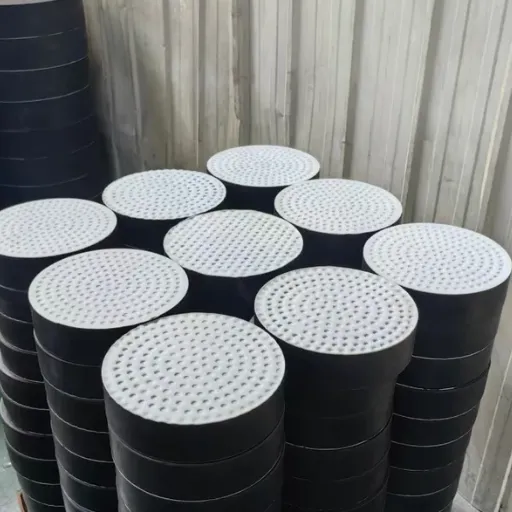 Read More
-
How to Choose a Bridge Rubber Bearing Manufacturer
October 23, 2026Choose a bridge rubber bearing manufacturer that can work from the approved bearing schedule, control materials and fabrication, p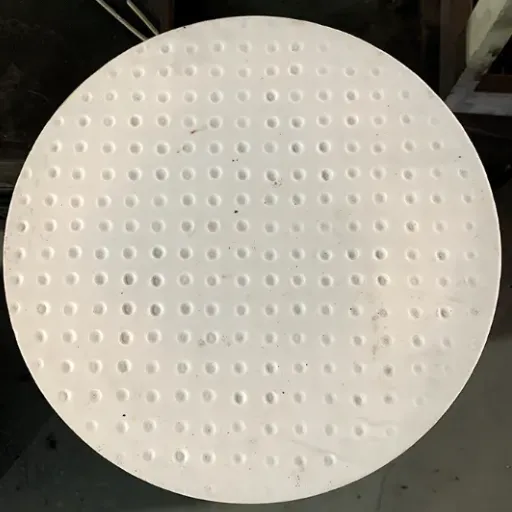 Read More
-
Fiberglass Trench Drain Channel: Selection and Installation Guide
October 21, 2026A fiberglass trench drain channel should be selected as a complete drainage system, not by width alone. Define the design flow, ro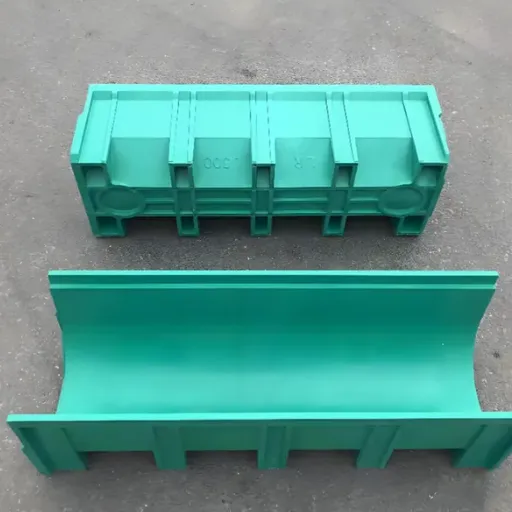 Read More
-
How to Choose an FRP Drainage Channel Manufacturer
October 20, 2026Choose an FRP drainage channel manufacturer that can translate your flow, liquid exposure, loads, route, and installation conditio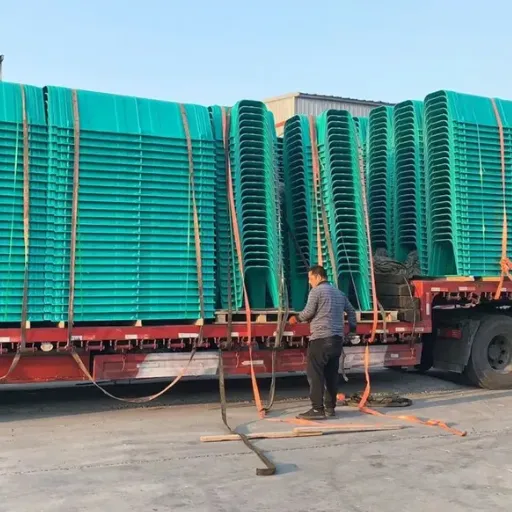 Read More

Contact Us
Recommended Products
-
 Corrosion Resistant Grating Board FRP Fiberglass Grating for Sidewalk FloorNegotiableMOQ: 100 Square Meters
-
Outdoor Fiberglass Ladder Type FRP GRP Cable Tray for Industrial Cable SupportNegotiableMOQ: 50 Meters
-
FRP Pultruded Box Section Profiles as Durable Building Material for ConstructionNegotiableMOQ: 300 Pieces
-
FRP/GRP U-Shape Trench Cover for Road Drainage ApplicationsNegotiableMOQ: 1 Set
-
Steel Grating Drainage Cover and Catwalk Walkway GratingNegotiableMOQ: 300 Square Meters
-
Sliding Neoprene Elastomeric Bridge Bearing Pad for Expansion Joints Low FrictionNegotiableMOQ: 1 Piece
-
FRP Plastic Septic Tank for Chemical Plant School Hotel Hospital Sewage TreatmentNegotiableMOQ: 1 Set
-
Customized High Load Polymer Concrete Drainage Channel - OEM AvailableNegotiableMOQ: 1 Set
-
Pot Type Bridge Rubber Bearing Pad for Seismic Isolation and Shock Absorption SupportNegotiableMOQ: 50 Pieces
-
Outdoor FRP Ladder Cable Tray UV Stabilized GRP Fiberglass Ladder Tray for Solar Power StationNegotiableMOQ: 50 Meters
-
Anti-Aging FRP Fiberglass GRP Pultrusion Grating for Outdoor ApplicationsNegotiableMOQ: 100 Square Meters
-
China Manufactures High Performance Bridge Rubber Pot BearingNegotiableMOQ: 1 Piece
-
Weatherproof Structural FRP Square Rectangular Tube Pultruded Profile for Outdoor UseNegotiableMOQ: 300 Pieces
-
Isolation Spherical Bearing and Damping Pad for Bridge Seismic ProtectionNegotiableMOQ: 300 Pieces
-
Fiberglass FRP/GRP Biogas Septic Tank for Sewage Treatment and PurificationNegotiableMOQ: 1 Set
-
Fiberglass Reinforced Plastic Grating for Walkway Flooring, FRP GRPNegotiableMOQ: 100 Square Meters
-
C-Channel FRP/GRP Pultruded Profiles for Structural SupportNegotiableMOQ: 300 Pieces
-
High Durability Molded FRP Grating for Walkways, GRP FiberglassNegotiableMOQ: 100 Square Meters
-
Laminated Rubber Bearings for Bridge and Building Seismic Isolator ApplicationsNegotiableMOQ: 50 Pieces
-
FRP Fiberglass Ladder Cable Tray for Power Supply and Electrical Wiring SystemsNegotiableMOQ: 50 Meters